

Solutions journalism stories are often more popular than traditional stories
Solutions journalism consistently outperformed other content.
“Those spotlight stories that are SoJo stories typically do better than others. Sometimes they perform as much as 75 percent better. … If we have a regular story with 3,000 views, a SoJo story gets around 4,500 within the first few days.”
— Innocent Eteng, Founder of Prime Progress (Nigeria)
“Since publishing solutions stories, our analytics have really gone high. … We can see a very big change in audience.”
— Mary Mwendwa, Journalist (Kenya)

Solutions journalism radio inspires audience engagement
People call in to express appreciation
“We received more than 50 calls about it. ... Even after the broadcast ended, people kept calling to say how much they appreciated what we did.”
—Junaidu Dahiru, Journalist (Nigeria)
People call in with requests
“Listeners reach out asking for more information. ... People wanted to know how to get in touch for training.”
—Sha’awanatu Isiaka Habu, Radio Reporter (Nigeria)
“Some listeners keep calling, asking why we stopped. They want us to come and see the solution in their community.”
—Junaidu Dahiru, Journalist (Nigeria)
People offer donations — a rarity in Nigeria
“Sometimes people ask, ‘Can I make a donation?’ In a climate where people rarely donate to media, that shows real impact.”
—Innocent Eteng, Prime Progress (Nigeria)

Solution replication is common and fast
When solutions stories show clear, doable steps, nearby communities copy them within weeks or months—often without outside prompting.
- Copying happened across topics: water access, public health, sanitation, peacebuilding.
- Journalists linked replication to stories that show practical steps and local ownership.
- Seeing “people like us” succeed increases belief that change is possible and sparks independent action.
- Replication can create a feedback loop: Communities request coverage of their own efforts, spreading learning further.

Solutions journalism builds community trust
- Journalists described a noticeable shift in trust after adopting a solutions lens.
- Audiences saw reporters less as critics exposing failures and more as allies in community development.
- The tone change strengthened the relationship: Communities began bringing reporters leads on what’s working.
- Engagement became more constructive, and invitations to cover local initiatives and share lessons increased.
- Several framed this as a restoration of journalism’s social contract, especially where sensational/political coverage had eroded trust.
Solutions stories featuring concrete fixes prompted rapid government follow-up
- A story about a community that built safer footbridges led county officials to clean and light crossings in Nairobi.
- A story about solar-power prompted a full hospital renovation in Nigeria.
- A story about a blood donation app inspired other counties to explore new technologies.
“After we broadcast that program [about solar power at hospitals] to the world, the state government has renovated that hospital and provided each and every ward of that hospital with solar-powered electricity. That is why the story is good and is very memorable to me.”
—Junaidu Dahiru, Journalist (Nigeria)

Community members say that solutions stories reminded them of their agency and inspired collective action
“You don’t have to wait for the government or any politician — you can help yourself. That is how we were able to end our problems in our area.”
—Gold City FM Focus Group, Nigeria
“We realized we could come together to form a group and rely on our community instead of folding our hands and waiting for the government. ... Now we’ve formed groups to protect ourselves.”
—Gold City FM Focus Group, Nigeria
“People just decide to do things. ... You don’t have to have a lot of resources. You can just decide to stand out.”
—Prime Progress Focus Group, Nigeria

Solutions journalism transforms journalists’ motivation
- Reporters described more optimism and purpose.
- Reporting on progress felt emotionally sustaining.
- Some said it improved their well-being.
- Many adopted a new reflex: Look for what’s working.
“Telling those stories became my therapy. … I felt lighter, more hopeful.”
— WhatsApp participant (Nigeria)
“Stopping at just reporting the problem is a choice. … I have the power to influence change.”
— WhatsApp participant (Nigeria)
Solutions journalism led to government action and policy change
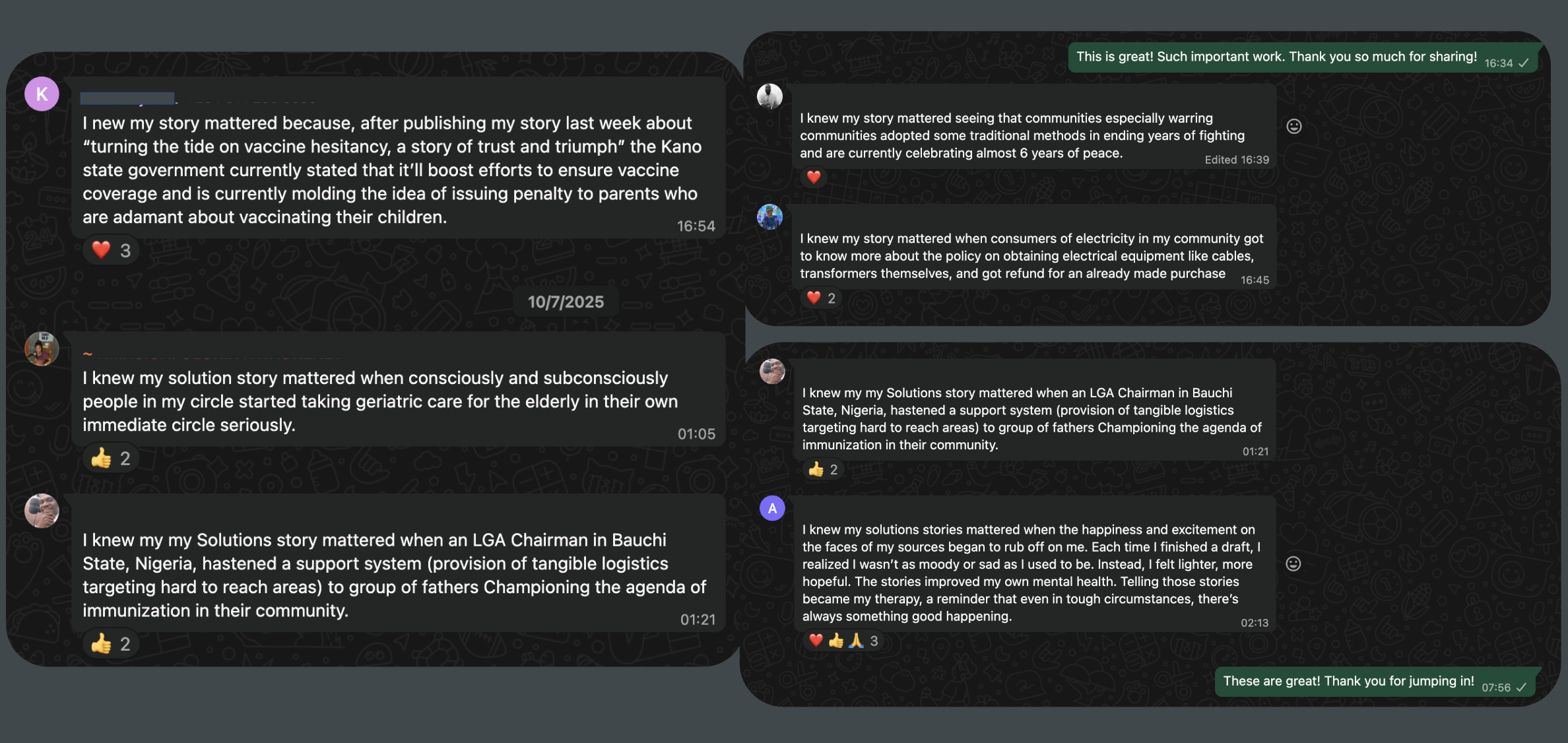
Closing Impact
“I knew my solutions stories mattered when the happiness and excitement on the faces of my sources began to rub off on me. Each time I finished a draft, I realized I wasn’t as moody or sad as I used to be. Instead, I felt lighter, more hopeful. The stories improved my own mental health. Telling those stories became my therapy, a reminder that even in tough circumstances, there’s always something good happening.”
“I see issues differently, and report them differently. I now understand that it’s my role to help people see that there’s always light at the end of the tunnel. No problem is unsolvable. And no effort is too small to bring about change and impact.”
—WhatsApp Activity Participants, Nigeria


